

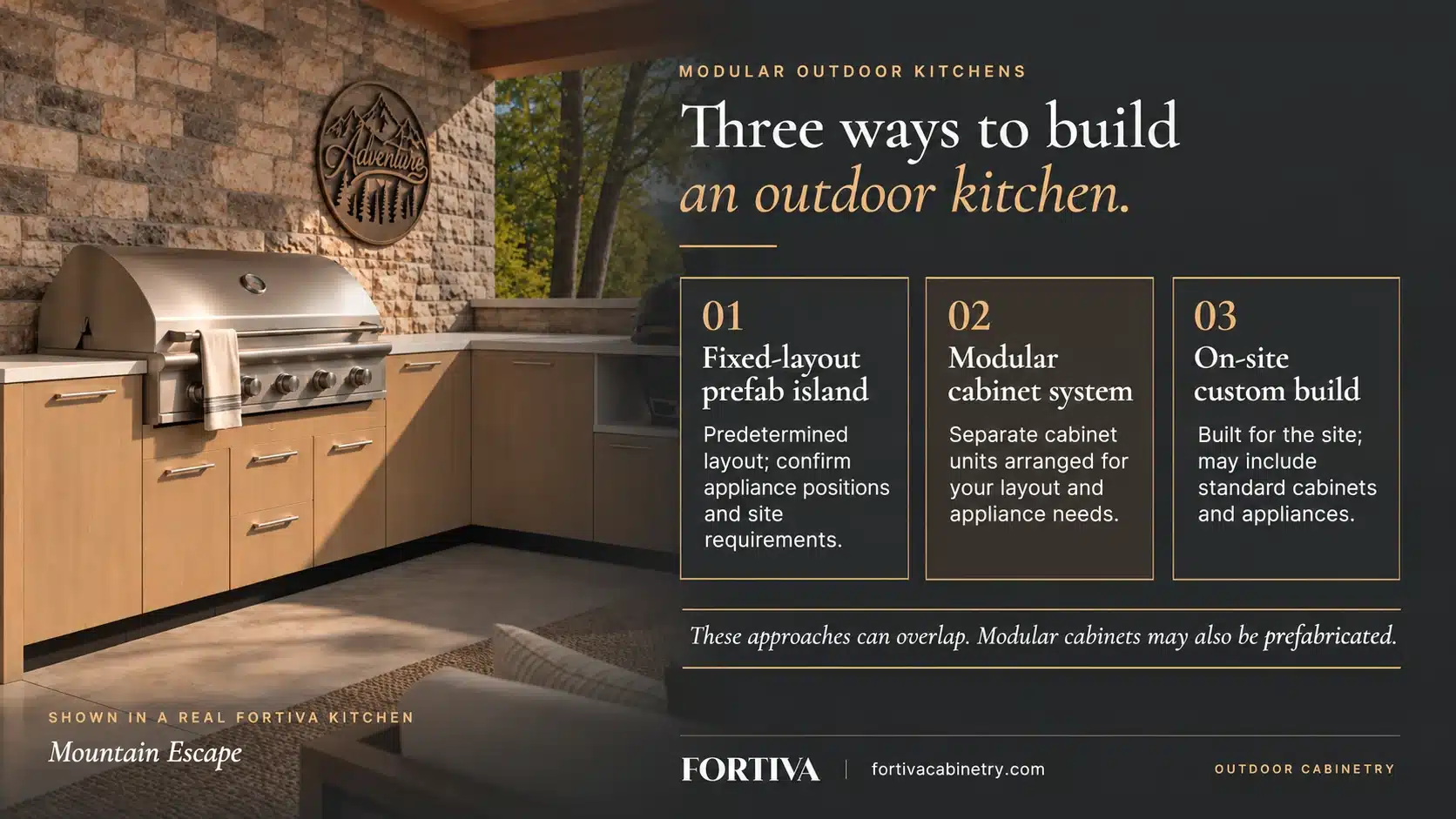
An outdoor kitchen can start with a fixed-layout island, separate cabinet units arranged for your space, or an on-site custom build. These approaches can overlap: modular cabinets may also be prefabricated. The practical difference lies in how much control you have over the layout, appliance placement, storage, and finishes. This guide explains how modular outdoor kitchens work and how Fortiva’s modular, semi-custom system can be planned with a dealer.
What is a modular outdoor kitchen?
A modular outdoor kitchen is made from separate cabinet units, each designed for a specific job, that line up side by side to form a run, an L-shape, an island, or another layout. Instead of one fixed unit, you choose the pieces: a grill cabinet here, a run of drawers there, a sink cabinet, an appliance cabinet, and storage.
Because every unit is built to set dimensions, the layout can be planned precisely before anything is ordered, and the finished kitchen looks like one continuous design rather than separate parts.
Three ways to build an outdoor kitchen
Fixed-layout prefab islands. Pre-configured units or sets with a largely fixed arrangement. Check what is included and what site preparation, utility connections, and installation are required. The available configuration needs to suit your space.
Modular cabinet systems. Individual cabinets in defined widths, selected and arranged for your space. You choose the layout, appliance positions, storage mix, and finish within the sizes the system offers. Planning is usually done with a dealer or designer.
On-site custom builds. Kitchens designed around a particular site, often using masonry, stone, or framing with cabinetry or inserts. They can combine standard products with custom elements. Design work, site conditions, and construction choices determine the schedule and flexibility.
None of these is right for everyone. The right choice depends on your space, how you cook, your timeline, and how much design control you want.
How a modular cabinet system comes together
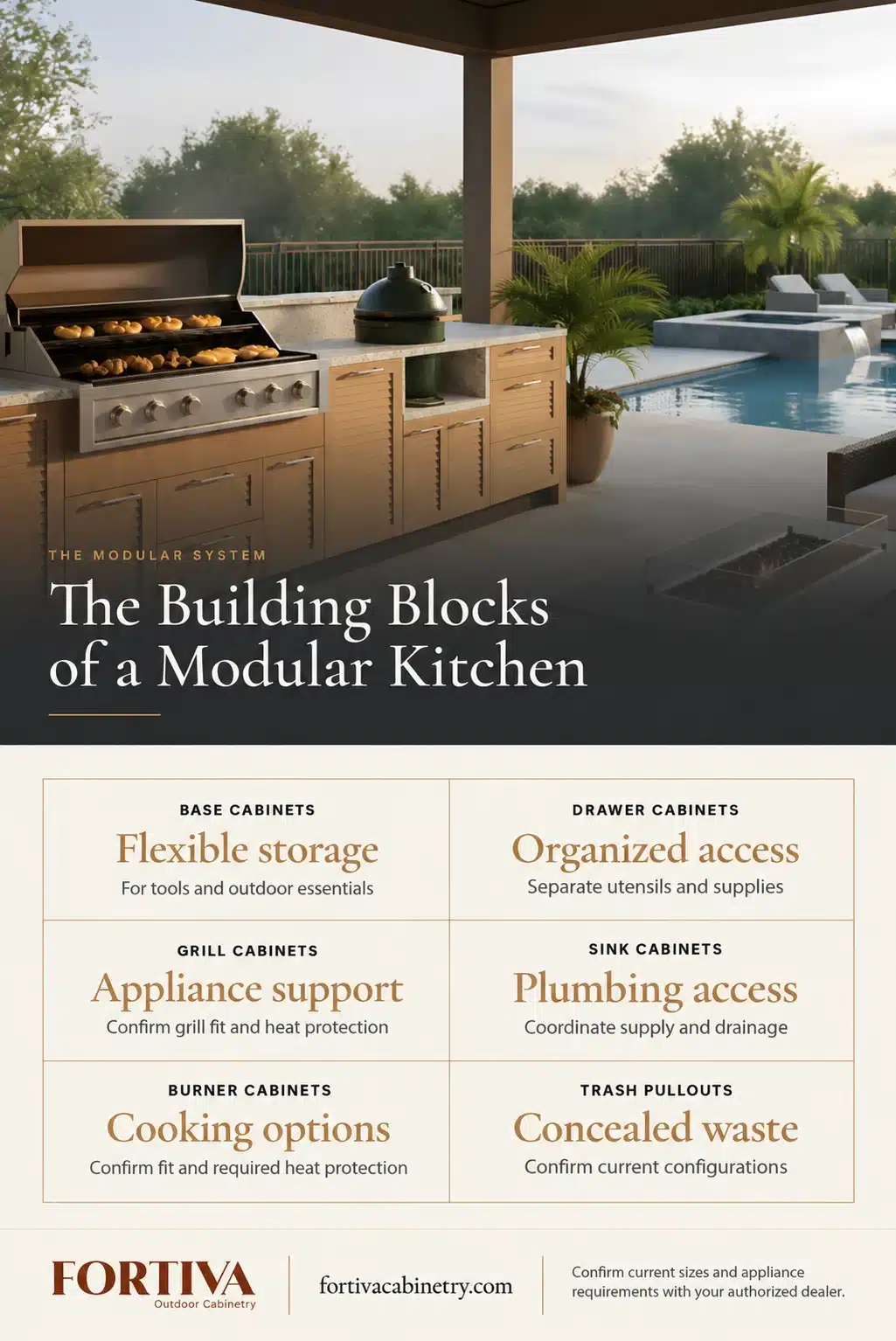
Fortiva is a modular, semi-custom system. Here is what the building blocks look like.
Base cabinets. Full-height storage in widths from 12 to 36 inches, in 3-inch increments, with a standard depth of 24 inches. The fine size steps make it easier to fill a run without awkward gaps.
Drawer cabinets. Three-drawer cabinets from 12 to 36 inches wide, with full-extension under-mount glides and soft-close drawers.
Grill cabinets. Built to house a grill, in 36, 42, 48, and 60-inch widths, 27 inches deep, with conduit points for gas and electrical connections.
Sink cabinets. In 18-, 21-, 24-, 30-, and 36-inch widths, with conduit points for plumbing.
Appliance cabinets. Options for outdoor equipment such as power burners and ceramic smokers. Confirm the current cabinet sizes, appliance compatibility, and installation requirements with your dealer.
Accessories. Storage options include trash pullouts, propane-tank storage, and pullout drawers. Check the current configurations and dimensions before including them in the design.
Side panels. Required on any exposed end for a finished appearance.
A dealer combines these units into your layout, checks appliance fit and clearances against the manufacturer’s requirements, and confirms the dimensions before placing the order.
Modular, semi-custom, and custom terminology
These words get used loosely, so it helps to be precise.
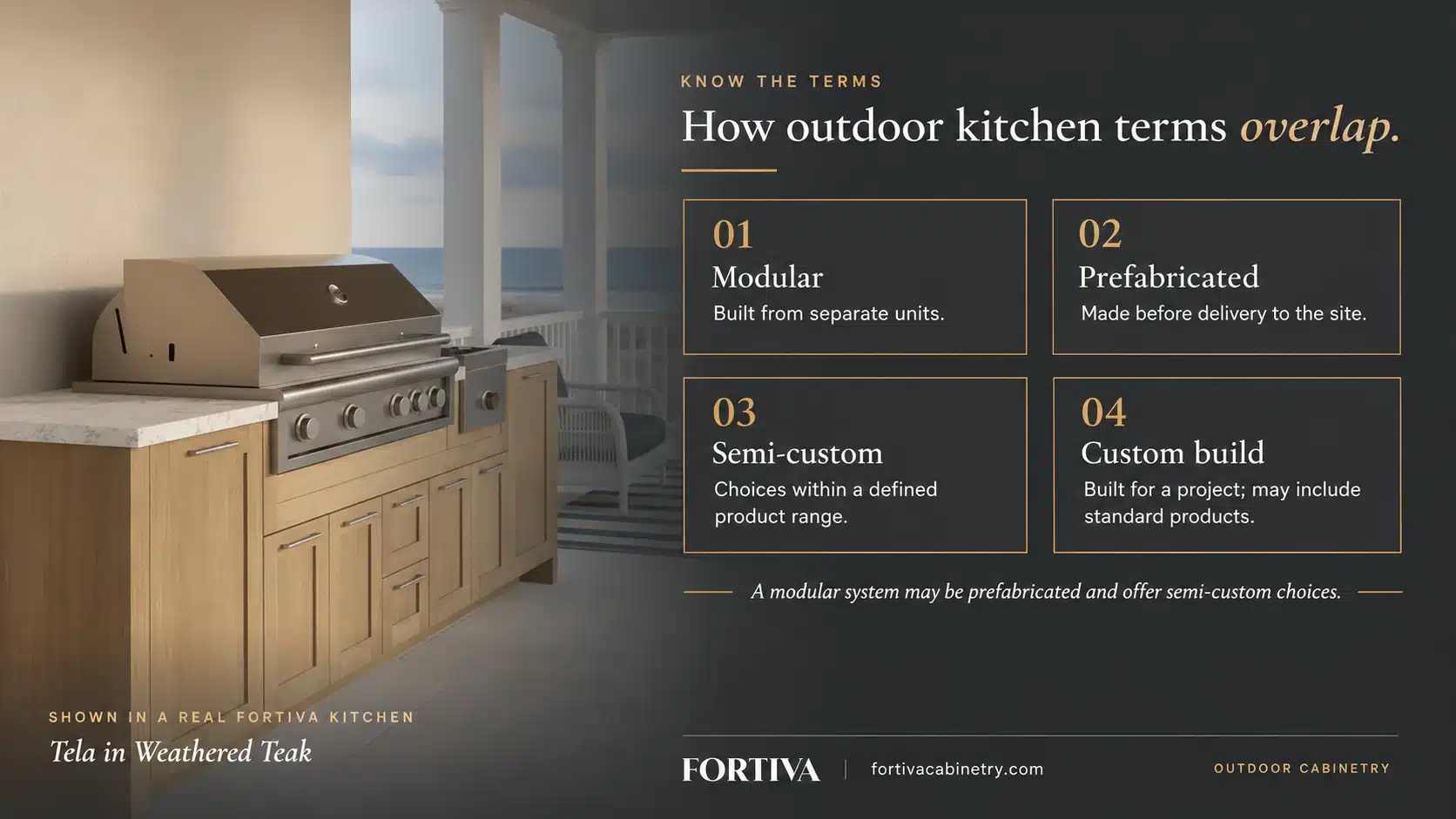
Modular describes construction from separate units. Those units may be prefabricated before they are delivered to the site.
Semi-custom describes the choices available within a manufacturer’s range, such as sizes, layouts, door styles, and finishes. Confirm which options and modifications the specific system offers.
Fully custom describes work designed for a particular project. A custom kitchen may still incorporate standard cabinetry, appliances, and other manufactured components.
Fortiva is modular and semi-custom. You choose from four door styles, Tela, Brezza, Filo, and Puro, and ten curated finishes: five paints in a smooth finish and five stains in a textured finish. The flexibility comes from how the units are combined, not from building each cabinet to order.
Advantages of a modular outdoor kitchen
Flexible layouts. Units can be arranged as a straight run, an L-shape, a U-shape, an island, or a combination, sized to your space.
Predictable planning. Because every unit has known dimensions, the kitchen can be laid out precisely in advance, and appliance cutouts and clearances can be checked before ordering.
Consistent design. One door style and finish carried across matching units gives the kitchen a unified, built-in look.
Cabinetry made for outdoors. Fortiva cabinets are made from a proprietary outdoor-engineered material with finishes designed to help resist UV exposure, fading, moisture, and seasonal temperature changes.
Project timing. Ask your dealer for the current quoted lead time and coordinate it with permits, site preparation, utilities, and countertop fabrication.
Things to know before choosing modular
Sizes are defined. A modular system offers a set range of widths and cabinet types, so a very unusual shape may need creative planning or filler. A dealer can tell you early whether your design fits the system.
Appliances must be matched. Not every appliance fits every cabinet. Confirm dimensions, clearances, and ventilation with the appliance manufacturer and your dealer.
Installation still matters. A modular kitchen needs an appropriate base, drainage, utility work, and correct appliance fitting. Fortiva recommends professional installation. Review the Fortiva product FAQs and the installation instructions for your cabinetry and appliances.
Finishes are chosen up front. Fortiva cabinets are not designed to be refinished later, so it is worth seeing finish samples in your own outdoor light before you decide.
Upgrading an existing masonry kitchen
Modular cabinetry is not only for new builds. Many older outdoor kitchens are masonry or stone structures with stainless steel doors and inserts that can rust over time. Fortiva offers weather-resistant cabinetry solutions that can replace rust-prone inserts in these applications. A dealer can assess whether your existing structure is a good candidate.
Planning a modular outdoor kitchen with a dealer
Plan the layout with your Fortiva dealer: choose cabinet units, position appliances, allow for storage, select the door style and finish, and confirm appliance fit. Our outdoor kitchen island ideas guide provides layout examples to discuss.
Fortiva Outdoor Cabinetry is available through authorized dealers nationwide. To connect with a dealer and discuss your layout, contact Fortiva.
Frequently asked questions
What is a modular outdoor kitchen?
A modular outdoor kitchen is built from separate cabinet units in defined sizes, arranged into a layout for your space. Units may include base, drawer, grill, sink, and appliance cabinets. The layout choices depend on the sizes and options offered by the manufacturer.
What is the difference between a modular and a prefab outdoor kitchen?
The terms can overlap. Prefabricated describes something made before it arrives at the site; modular describes construction from separate units. A fixed-layout prefab island offers a preconfigured arrangement, while a modular cabinet system lets you select units and plan their positions within the available space.
Are modular outdoor kitchens custom?
A modular system may offer semi-custom choices, but the terms describe different things. Fortiva is modular and semi-custom: you choose a layout, cabinet units, door style, and finish within its defined product range.
Can modular outdoor kitchen cabinets fit any grill?
Not every grill fits every cabinet. Fortiva grill cabinets come in 36-, 42-, 48-, and 60-inch widths, and the cabinetry is designed to work with many outdoor appliances. Still, dimensions, clearances, and ventilation must always be confirmed with the appliance manufacturer and your dealer.
Can I replace the rusting inserts in my outdoor masonry kitchen?
Often, yes. Fortiva offers weather-resistant cabinetry solutions that can replace rust-prone stainless steel inserts in stone or brick outdoor kitchen structures. A dealer can assess your existing structure.
Do modular outdoor kitchens need professional installation?
Yes. Fortiva recommends professional installation for best results. A modular kitchen still needs a level, well-drained base, licensed gas, electrical, and plumbing work, and correct appliance clearances and ventilation.