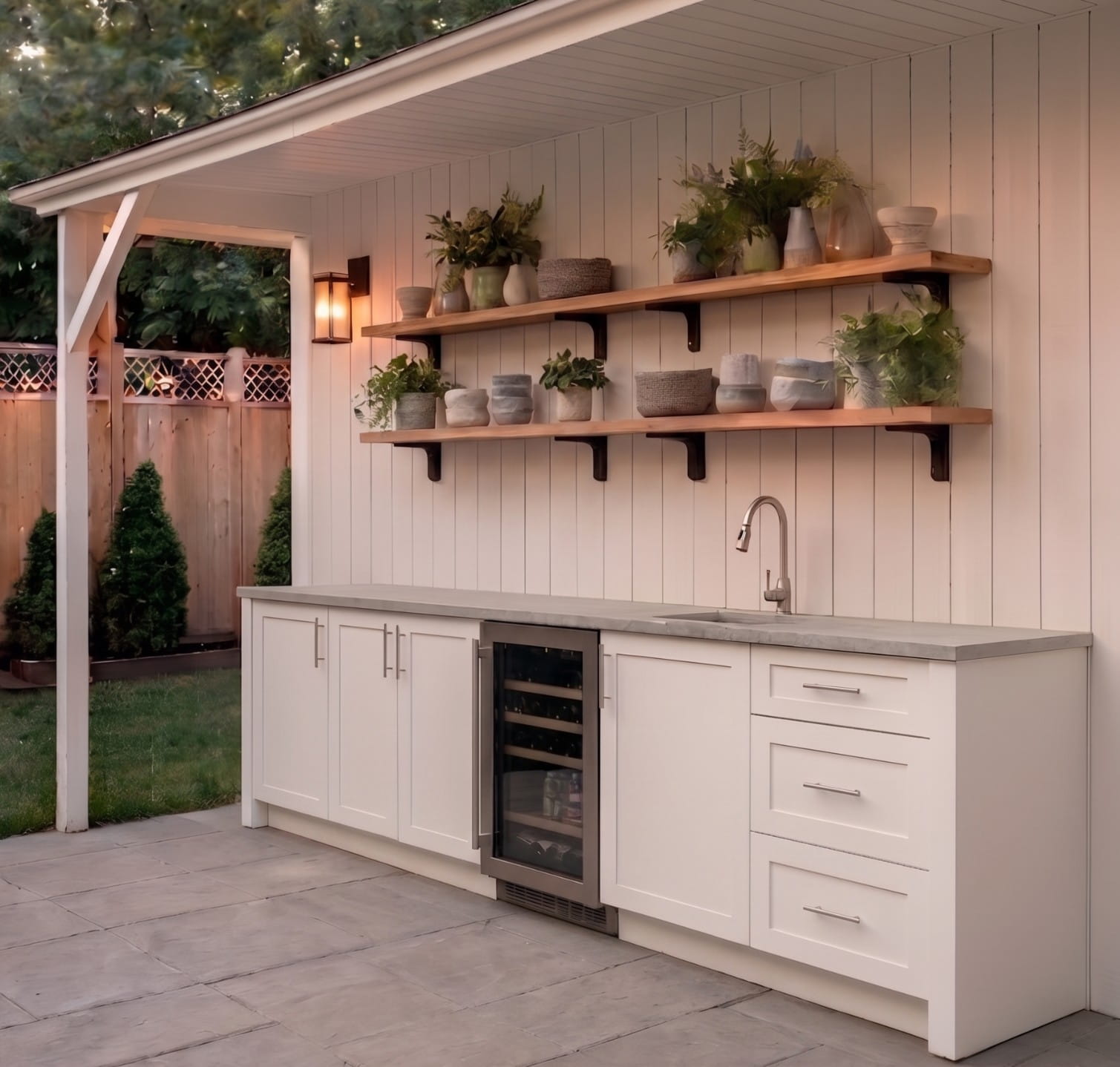


Exterior cabinets are engineered for long-term durability in outdoor kitchen environments, making them fundamentally different from modified indoor cabinets. While both options may appear similar in terms of door styles, finishes, and hardware, their performance diverges significantly when exposed to real-world conditions such as moisture, UV exposure, and temperature fluctuations.
Luxury outdoor kitchens are fully integrated systems that can include refrigeration, heat-generating appliances, plumbing, and lighting. Specifying outdoor kitchen cabinetry as if it were interior millwork introduces risk of premature failure, increased maintenance, and reduced project lifespan.
According to the USDA Forest Products Laboratory, repeated moisture cycling causes dimensional changes in wood-based materials, leading to joint failure, degradation, and long-term structural instability.
Our outdoor cabinet experts compare exterior-rated outdoor cabinets vs modified indoor cabinets, focusing on materials, durability, ventilation, and installation performance.
Key Takeaways on Outdoor Cabinets
- Exterior-rated outdoor cabinets are engineered to withstand moisture, heat, and UV exposure.
- Modified indoor cabinets often fail due to dimensional movement and material degradation.
- Ventilation planning significantly affects cabinet longevity and appliance performance.
- Installation coordination with structural conditions improves real-world outcomes.
- Lifecycle cost analysis typically favors purpose-built outdoor cabinetry systems.
Why Exterior Cabinets Outperform Standard Indoor Cabinetry
Exterior-rated outdoor cabinets are designed to withstand environments with humidity fluctuations, ultraviolet radiation, and temperature expansion cycles. These systems use substrates and structural framing approaches that resist moisture absorption and maintain dimensional stability over time.
Common construction features include:
- Aluminum framing components
- Stainless steel fasteners
- UV-stabilized finishes
These materials are selected not only for durability but for predictable movement characteristics. When cabinetry maintains alignment, door function improves, and hardware wear is reduced.

The International Code Council (ICC) emphasizes that exterior assemblies must be specified based on exposure classification rather than solely on surface protection. Weather-resistant outdoor cabinets, therefore, incorporate ventilation allowances and drainage strategies that help regulate internal conditions.
Builders who understand these engineering principles are better positioned to avoid costly replacements and warranty disputes. Exterior-rated construction shifts cabinetry from a decorative upgrade to a performance-driven building component.
Modified Indoor Cabinets Often Fail Due to Material Movement
Modified indoor cabinets are typically adapted through:
- Sealants
- Exterior paint systems
- Placement under covered structures
While these strategies can delay deterioration, they rarely address the underlying issue of substrate movement.
Wood-based panels, such as particleboard or MDF, absorb moisture when exposed to humidity cycling. Therefore, expansion and contraction of wood can lead to delamination, joint separation, and finish cracking. In outdoor kitchens where appliances generate heat and condensation, these stresses become more pronounced.
Builders may initially perceive modified indoor cabinets as a cost-saving measure. However, replacement often involves removing the countertop, demolishing surrounding finishes, and additional labor. Lifecycle cost considerations favor purpose-built exterior cabinetry in many high-end projects.
Ventilation and Heat Management Create Performance Divides
Outdoor kitchen cabinetry operates within microclimates shaped by:
- Cooking activity
- Refrigeration cycles
- Weather exposure
Without proper airflow pathways, humidity and heat accumulate inside cabinet boxes.
Trapped moisture in enclosed assemblies accelerates material degradation and corrosion. Exterior-rated outdoor cabinets typically incorporate passive ventilation gaps, perforated panels, or clearance zones that allow air circulation.
Modified indoor cabinets are often installed tightly within masonry surrounds or sealed beneath countertops. This configuration restricts airflow, increasing the likelihood of hardware corrosion and finish discoloration. Appliance performance can also suffer when heat cannot dissipate effectively.
Specifiers who plan ventilation during cabinet layout development reduce both maintenance risk and appliance warranty concerns.
Installation and Structural Integration Influence Longevity
The performance gap between exterior-rated outdoor cabinets and modified indoor cabinets becomes even more apparent during installation. Outdoor cabinetry must accommodate slab slope, deck deflection, and thermal movement between materials.
Exterior systems often include adjustable leg platforms or integrated framing to help maintain level alignment. Modified indoor cabinets, by contrast, are often shimmed or fastened directly to substrates without accounting for environmental movement.

Guidance from the American Wood Council highlights that structural deflection can transfer stress into attached millwork components, affecting door operation and finish integrity. Builders who coordinate cabinetry specification with structural planning achieve more predictable results.
Installation sequencing also matters. Cabinet placement should occur before countertop templating to ensure a precise fit and appliance clearance. Exterior-rated systems are typically designed with modular flexibility that supports field adjustments without compromising performance.
How Should Specifiers Evaluate Options for Exterior Cabinets?
Builders, architects, and designers evaluating cabinetry solutions for outdoor kitchens should follow the steps below.
- Begin by assessing project exposure conditions. Coastal environments, uncovered patios, and poolside installations introduce higher humidity and corrosion risk. Exterior-rated outdoor cabinets are generally better suited to these scenarios.
- Teams should review appliance specifications and ventilation requirements. Aligning the cabinet layout with heat-generating equipment helps prevent premature material stress.
- Designers can also coordinate finish palettes and hardware selections early to maintain visual cohesion across outdoor living zones.
- Partner with a specialized outdoor cabinetry manufacturer or dealer during design development for valuable insight into lead times, installation sequencing, and warranty documentation. This collaboration reduces the likelihood of late-stage substitutions that can compromise performance.
Frequently Asked Questions About Exterior Cabinets
Can indoor cabinets be made suitable for outdoor use with sealants?
Surface coatings can slow deterioration but usually do not prevent internal moisture-related movement.
What materials are commonly used in exterior-rated outdoor cabinets?
Marine-grade polymer panels, aluminum framing systems, and corrosion-resistant hardware packages are frequently specified.
Do covered patios eliminate environmental risk for cabinetry?
Covered spaces still experience humidity, temperature fluctuation, and indirect weather exposure.
Why is ventilation important in outdoor cabinet installations?
Airflow helps regulate temperature and humidity, reducing the risk of corrosion and finish failure.
When should cabinetry decisions be finalized during construction?
Ideally, during schematic design, it is necessary to make it easy to coordinate structural openings, appliance placement, and utility routing.
Design Your Exterior Cabinets with Fortiva Outdoor Cabinetry
By approaching cabinetry selection through a performance lens, project teams can deliver outdoor kitchens that meet luxury client expectations for both aesthetics and durability.
Exterior-rated outdoor cabinets offer measurable advantages over modified indoor cabinets when projects demand long-term durability, structural stability, and predictable performance. While adaptation strategies may appear cost-effective initially, they often introduce risks related to moisture movement, ventilation limitations, and installation challenges.
Fortiva Outdoor Cabinetry works with builders, architects, and designers to support specification decisions with engineered outdoor cabinet systems designed for real environmental exposure.
Contact our team to share your drawings and explore how exterior-rated cabinetry solutions can strengthen your next outdoor kitchen project.